Kuta Mandalika, located in Central Lombok Regency, West Nusa Tenggara, has become one of Indonesia’s most attractive investment destinations, particularly in the tourism, hospitality, restaurant, villa, and property development sectors. Its tourism potential, beautiful natural landscapes, and the presence of the Mandalika Special Economic Zone (SEZ) offer promising opportunities for investors.
However, behind these opportunities lie several legal and regulatory aspects that must be understood before purchasing land, making an investment, or starting a construction project. One common misconception among investors is that having a valid land ownership certificate automatically means that the land can be developed for any intended purpose.

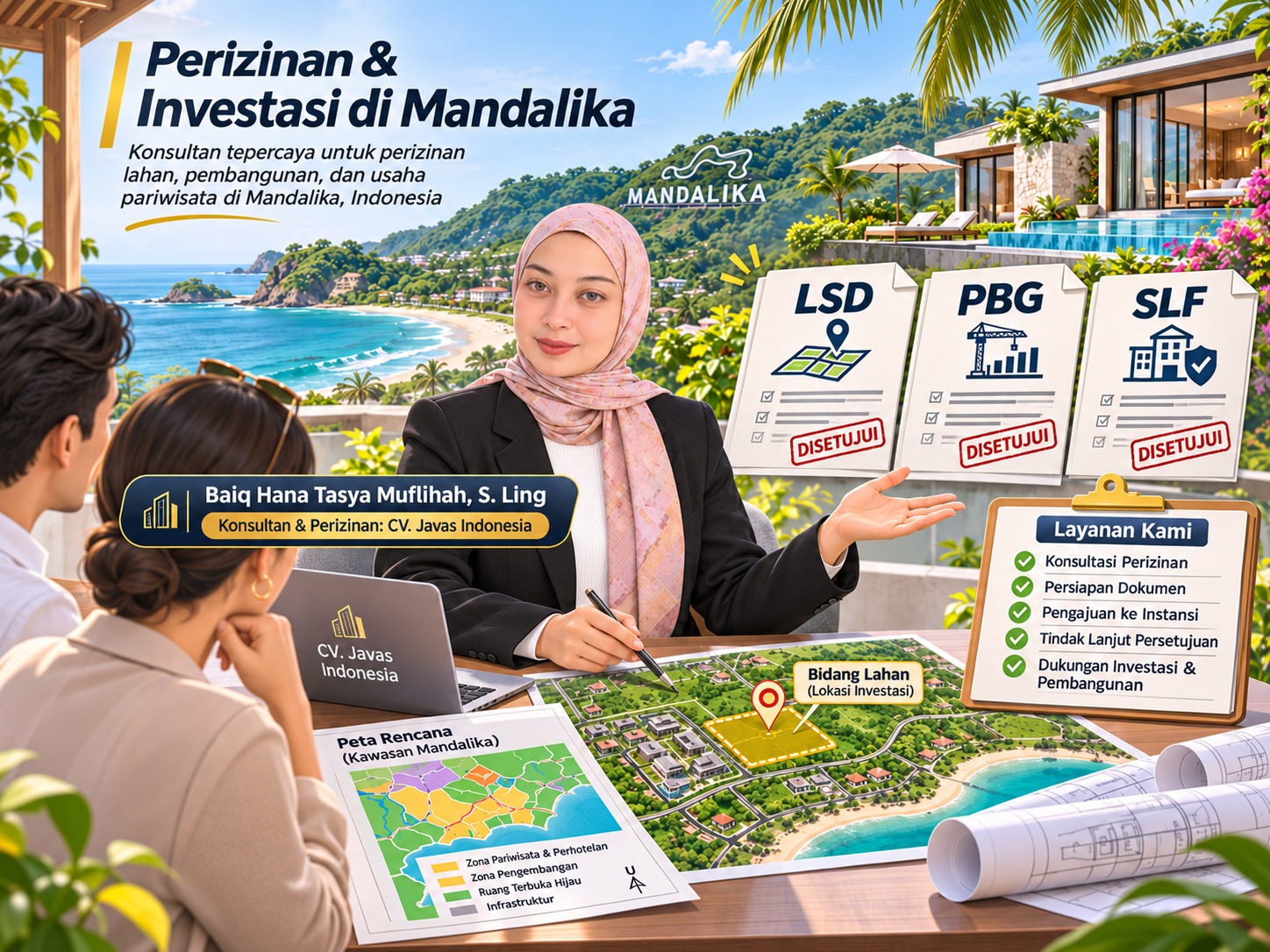
In reality, land utilization is subject to spatial planning regulations, agricultural land protection policies, and building technical requirements. Three important aspects that every investor should understand from the beginning are Protected Rice Fields (Lahan Sawah Dilindungi/LSD), Building Approval (Persetujuan Bangunan Gedung/PBG), and the Certificate of Functional Worthiness (Sertifikat Laik Fungsi/SLF).
Understanding these three aspects is not merely about fulfilling administrative obligations. It is also an essential step in protecting investment value and preventing potential legal complications in the future.
1. Understanding Protected Rice Fields (LSD): Avoid Buying Land Without Checking Its Status
Protected Rice Fields (Lahan Sawah Dilindungi/LSD) are part of the government’s policy to control the conversion of rice fields and maintain the availability of agricultural land as a foundation for national food security.
The current regulatory framework governing the control of rice field conversion is Presidential Regulation No. 4 of 2026 concerning the Control of Rice Field Conversion, which replaced Presidential Regulation No. 59 of 2019.
This regulation establishes procedures for verifying and determining LSD maps, including controlling changes in land use for areas included in the designated protection maps.
Why is this important for investors in Kuta Mandalika?
In practice, an individual may legally own a land certificate, but the land may still be subject to restrictions on how it can be utilized. In other words, land ownership does not automatically grant the right to convert agricultural land into commercial buildings, villas, hotels, restaurants, or other tourism-related facilities.
Under Article 17 of Presidential Regulation No. 4 of 2026, rice fields included in the LSD map but not yet designated as part of sustainable food agricultural land or areas under the applicable spatial planning framework cannot be converted before obtaining the required land-use change recommendation from the competent minister.
Therefore, prospective investors should verify the land’s status through official land administration and spatial planning maps using the actual coordinates of the property.
This verification should be completed before entering into a sale and purchase transaction, making a down payment, or signing an investment agreement. Investors should avoid purchasing land simply because it has an attractive location or competitive price without first understanding its land-use restrictions.
2. Understand Kuta Mandalika’s Spatial Planning Before Deciding What to Build
In addition to LSD, another equally important consideration is the conformity of the proposed land use with spatial planning regulations.
Central Lombok Regency has established Regent Regulation No. 105 of 2021 concerning the Detailed Spatial Plan (RDTR) for the Area Surrounding the Mandalika Special Economic Zone for 2021–2041.
The RDTR serves as an important reference for determining spatial allocation and the types of activities permitted in a particular location.
For example, an investor may plan to purchase land around Kuta Mandalika to develop a villa or hotel. Before proceeding with construction, it is essential to verify whether the property is located in a designated zone that permits tourism and accommodation activities.
Investors should also consider the applicable technical spatial planning requirements, including:
- Building Coverage Ratio (Koefisien Dasar Bangunan/KDB).
- Floor Area Ratio (Koefisien Lantai Bangunan/KLB).
- Maximum building height.
- Building setback requirements.
- Permitted land uses based on the applicable zoning and sub-zoning classifications.
Each location may have different requirements. Therefore, it is incorrect to assume that every plot of land in Kuta Mandalika can automatically be developed for tourism-related property projects.
Investors should also pay attention to the Spatial Utilization Activity Suitability Approval (Kesesuaian Kegiatan Pemanfaatan Ruang/KKPR), which confirms whether a proposed activity is consistent with the applicable spatial planning regulations.
Consequently, spatial planning verification should be an integral part of the initial investment feasibility assessment, rather than something considered only after the land has been purchased or the construction project has been planned.
3. PBG: An Essential Requirement Before Starting Construction
After confirming the land’s legal status and spatial planning suitability, the next step is understanding Building Approval (Persetujuan Bangunan Gedung/PBG).
PBG is an approval granted to building owners for the construction of new buildings, as well as alterations, extensions, reductions, or maintenance of buildings, in accordance with applicable building technical standards.
The regulatory framework for PBG is established under Government Regulation No. 16 of 2021 concerning the Implementation of the Building Law, and is also related to business licensing requirements under Government Regulation No. 28 of 2025.
Under Article 108 of Government Regulation No. 28 of 2025, business operators must obtain PBG before commencing construction of buildings required as business facilities.
PBG is not merely an administrative document. Its application process requires building technical plans to comply with established standards, including requirements relating to building safety, health, comfort, and accessibility.
For investors planning to develop hotels, villas, restaurants, or other commercial facilities in Kuta Mandalika, PBG must be prepared in accordance with the intended function and characteristics of the proposed building.
It is important to understand that PBG cannot replace land status verification or spatial planning compliance. Similarly, spatial planning approval does not automatically authorize construction without fulfilling the applicable PBG requirements.
These are separate regulatory requirements, and both must be fulfilled in accordance with the applicable laws and regulations.
4. SLF: Completing Construction Does Not Automatically Mean the Building Can Be Used
Another issue that building owners sometimes overlook is the assumption that once construction is physically completed, the building can immediately be used for business activities.
In fact, there is another important requirement that must be fulfilled: the Certificate of Functional Worthiness (Sertifikat Laik Fungsi/SLF).
SLF is a certificate confirming that a building has fulfilled the applicable functional requirements and is suitable for use in accordance with its designated purpose.
Referring to Article 122 of Government Regulation No. 28 of 2025, business operators are required to obtain SLF before utilizing the building.
The issuance process involves verifying the building’s functional suitability based on applicable technical requirements. These assessments cover building conditions, structural reliability, safety, health, comfort, and accessibility.
For example, an investor has completed the construction of a villa in Kuta Mandalika. Although the building is physically complete and all facilities are available, the owner must still ensure that the SLF requirements have been fulfilled before using the property for business activities.
This is particularly important for buildings intended to serve the public or tourists, such as hotels, villas, restaurants, and other commercial facilities.
Therefore, PBG and SLF serve interconnected but different purposes:
- PBG (Building Approval): Approval that must be obtained before construction begins.
- SLF (Certificate of Functional Worthiness): Certificate that must be obtained before the building is utilized.
Both are essential components of proper and legally compliant building development.
5. What Are the Risks of Ignoring LSD, PBG, and SLF?
Ignoring legal and licensing requirements from the beginning can create various risks that directly affect the sustainability of an investment.
Some potential risks include:
First, land-use restrictions. The purchased property may fall within an area subject to specific restrictions, including LSD or other areas with particular spatial planning requirements.
Second, construction delays. Development plans may encounter obstacles if the location, intended building function, or required documentation does not comply with applicable regulations.
Third, additional investment costs. Design modifications, adjustments to building functions, additional licensing procedures, and the resolution of legal issues may increase costs beyond the original investment budget.
Fourth, administrative sanctions. Land utilization or building construction that violates applicable regulations may result in administrative measures, including suspension of activities and other enforcement actions in accordance with the relevant laws and regulations.
Fifth, operational and asset value risks. Buildings that have not fulfilled the required licensing conditions may face difficulties in being utilized for business activities. Such circumstances may also affect business partnerships, financing arrangements, and future property transactions.
These risks demonstrate that legal due diligence should not be viewed as an unnecessary additional expense. Instead, it is an essential investment strategy to protect capital and ensure business continuity.
6. What Should Investors Do Before Purchasing Land and Building in Kuta Mandalika?
To ensure that an investment is properly planned, prospective investors should conduct a series of checks before making a final decision.
The following steps should be considered:
- Verify land ownership and legal status, including ownership certificates, land boundaries, land rights, and any potential disputes or encumbrances.
- Check LSD and LP2B status using the property’s coordinates and the applicable official maps and databases.
- Confirm spatial planning compliance, including zoning allocation, sub-zoning classifications, and the suitability of the proposed business activities through the KKPR mechanism.
- Conduct a preliminary assessment of the proposed development, including building function, building area, height, Building Coverage Ratio (KDB), Floor Area Ratio (KLB), and other technical requirements.
- Verify environmental approval requirements, such as AMDAL, UKL-UPL, or SPPL, depending on the scale and characteristics of the proposed business activity.
- Prepare and obtain PBG before construction, ensuring that all applicable building technical requirements are fulfilled.
- Obtain SLF before utilizing the building for business activities.
These steps should ideally be carried out with the assistance of professionals who understand land administration, spatial planning, environmental regulations, construction, and licensing procedures.
Comprehensive due diligence can help investors gain a clearer understanding of a property’s feasibility before committing substantial financial resources.
Safe Investment Begins with Legal Certainty
Kuta Mandalika offers significant opportunities for investment and economic development, particularly in the tourism and property sectors. However, the economic potential of an area should not be the sole consideration when making investment decisions.
Every land acquisition and construction project should be supported by proper legal verification, spatial planning compliance, agricultural land protection considerations, and fulfillment of building technical requirements.
Understanding LSD, PBG, and SLF from the beginning is an essential step in preventing investment mistakes that could lead to financial losses or legal complications.
Do not simply make sure that the land you purchase has a valid ownership certificate. Make sure that the land can be utilized for your intended purpose, the building can be legally constructed, and the completed development can be used in accordance with applicable regulations.
CV. Javas Indonesia serves as a professional consulting partner, assisting investors with spatial planning assessments, licensing requirements, environmental documentation, and Building Approval (PBG) and Certificate of Functional Worthiness (SLF) processes.
With proper planning and professional assistance, investors can prepare their projects in a more structured, measurable, and legally compliant manner.
Before purchasing land or starting construction in Kuta Mandalika, make sure you understand the legal status and licensing requirements first. Because a successful investment is not only about choosing a strategic location, but also about ensuring legal certainty and long-term business sustainability.
Author: Baiq Hana Tasya Muflihah, S. Ling.
Consultant & Licensing Services: CV. Javas Indonesia
Environmental, Spatial Planning, Construction, and Licensing Consultancy.
Bila artikel ini memberi informasi atau sudut pandang yang berguna, kirimkan tepuk tangan sebagai apresiasi kepada tim redaksi. Terima kasih telah membaca. Apresiasi Anda membantu redaksi terus menghadirkan liputan dan cerita berikutnya. Proses pembayaran dilakukan dengan aman. Apresiasi Anda sudah kami terima. Dukungan ini membantu redaksi terus menghadirkan karya yang informatif.Segelas Kopi untuk Wartawan
Terima kasih atas tepuk tangannya!